This page presents the database, its tables and fields, data input best practices, and the broader workflow for ensuring the reusability of CHIPS data.
Database
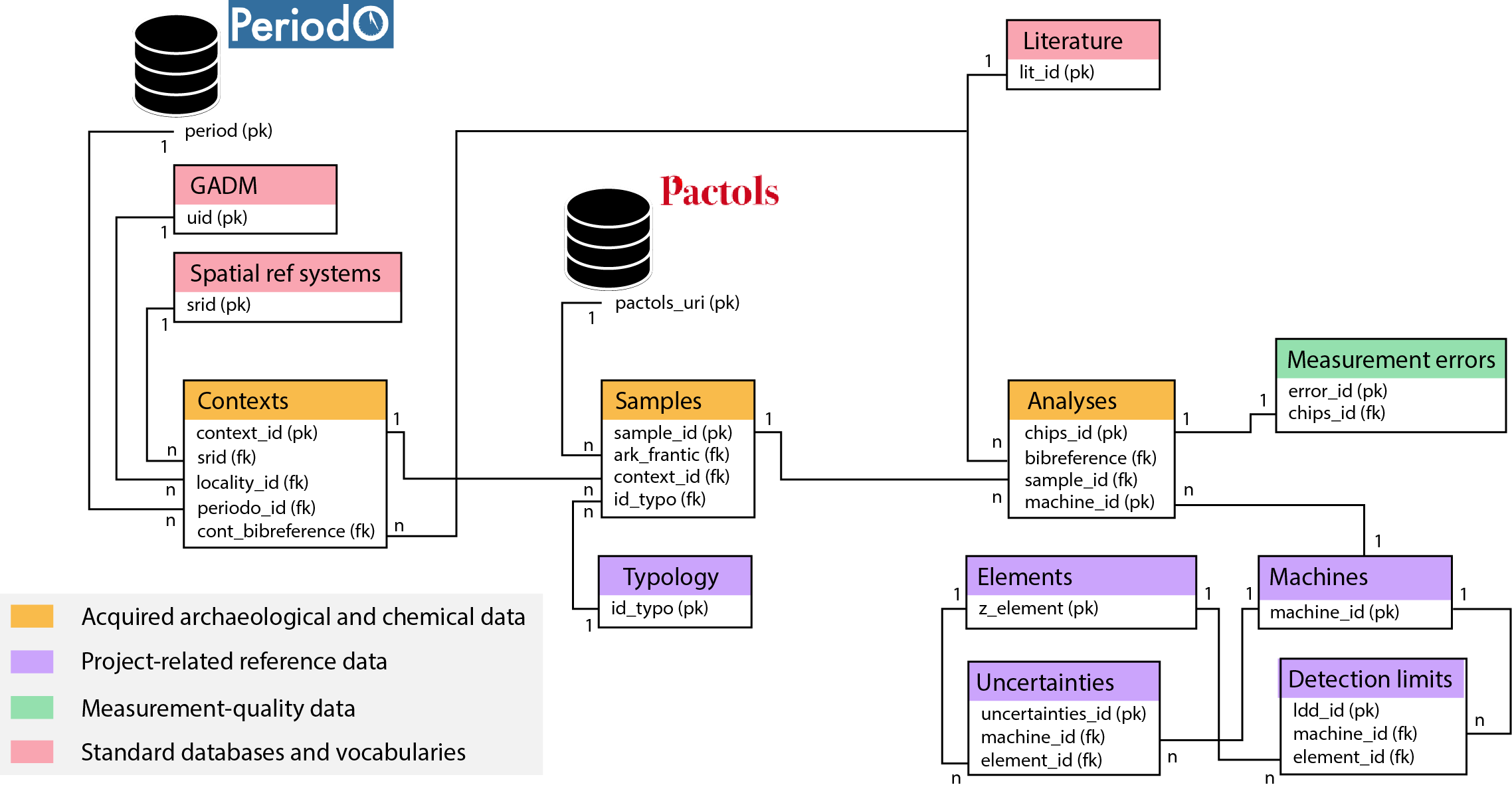
The database is built on PostgreSQL 11 and PostGIS v2.5. It relies on a simple data structure whose backbone consists of a context–sample–chemistry triplet. Each of these components is described by metadata designed either to assess data quality or to promote interoperability.

Simplified Entity–Relationship Diagram (ERD) of the CHIPS database.
Tables and fields
This section provides description on tables and tables’ fields.
Table descriptions
The dynamic datatable below describes the database tables:
Fields descriptions
The dynamic datatable below describes the fields of the database tables:
Data
Reference data
Reference data:
Analytical data
Open datasets, accessible throught the API, are listed here:
Corresponding biblographic references are listed in the section: references
Measurement errors
Recording measurement errors
The following protocol has been established for recording measurement errors:
- Identification of analytical setups: each setup is recorded in the
machinestable, specifying the type of chemical analysis, the laboratory, and the model of the analytical instrument used. - Identification of setup characteristics (i.e., measurement errors): for each analytical device listed in the
machinestable, each chemical element listed in theelementstable, and a given concentration range, the relative measurement uncertainty is recorded in theuncertaintiestable.
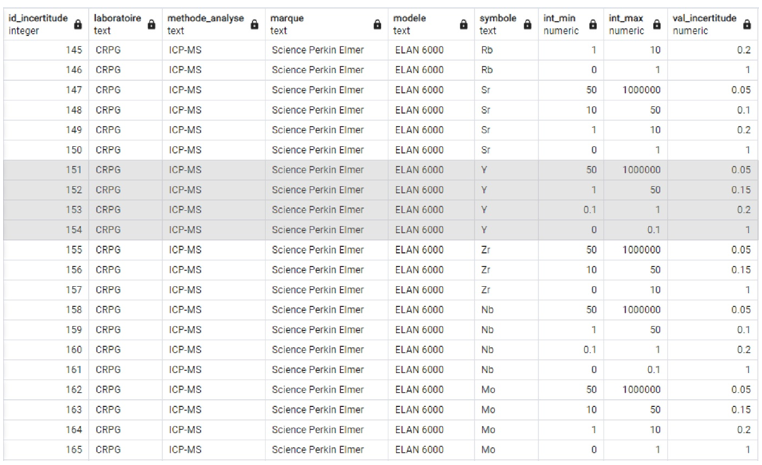
The query result shown in Figure 2 illustrates how these values are organised. Uncertainties 151 to 154 represent the relative measurement errors associated with the ICP-MS analyser used by the Centre de Recherches Pétrographiques et Géochimiques (CRPG) laboratory for the element yttrium. For concentrations above 50 mg·kg−1, the relative error is 5%. It increases to 15% for concentrations between 1 and 50 mg·kg−1, and reaches up to 100% for concentrations below 0.1 mg·kg−1.

View based on the machines, elements, and uncertainties tables, showing relative measurement uncertainties according to the analytical setup and measured concentration range.
Data entry
The data is extracted from a published datasets, curated and normalized with available metadata before being added to the Postgres database.
Data authorship
Beyond data standardisation and interoperability, the CHIPS project also aims to make datasets citable, meaning that your contribution can be cited independently of both the CHIPS database and other datasets.
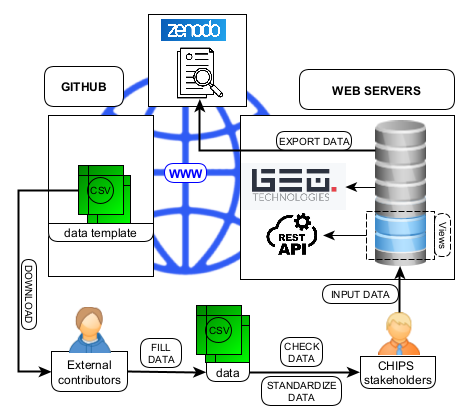
The simplified workflow below illustrates how contributed data are processed: once submitted, datasets are reviewed, integrated into the database, and published as independent datasets—with full attribution to contributors—in an open-access data repository (here, Zenodo).

Simplified CHIPS publication workflow (thick arrows).
Unless otherwise specified, your data will be subject to the CC BY 4.0 license. See, for example, the dataset_rsaage26 dataset hosted on Zenodo.
Contact
CHIPS uses GitHub as the primary platform for discussing data and software development; feel free to create an issue. Otherwise, for scientific questions (e.g., error calculations), please contact , and for IT-related questions (e.g., linked open data), please contact . See also the Contact section.
How-to-contribute
Contribute your data to CHIPS
An easy way to register your dataset in CHIPS and expose it as a standalone dataset is to complete and send us the template file chips_dataset_entry_template.xlsx, available for download from the CHIPS GitHub repository. Columns and value types are described in the Tables and values section of the database documentation.
Below is a preview of the template, including sample records from the dataset_rsaage26 dataset.
How-to-cite
cite the Data
Data coming from the CHIPS dashboard, from CSV exports, or directly from API URLs are separate entities distributed under the CC BY 4.0 license and can be cited individually (see the "reference" field). For example:

Cite a dataset exported from the API (from: http://157.136.252.188:3000/dataset_jmilot16)

Cite a dataset exported as CSV
cite the Database
The CHIPS database itself, which provides standardization and interoperability, should be cited separately from datasets:
@misc{chips_database,
title = {CHIPS Database -- CHImie en PaléoSidérurgie},
author = {{IRAMAT-CNRS}},
institution = {IRAMAT-CNRS},
publisher = {IRAMAT-CNRS},
year = {2026},
url = {https://iramat-apps.cnrs.fr/dash/},
note = {Online database, accessed 2026-05-11},
organization = {IRAMAT-CNRS},
ror = {https://ror.org/01cw28e72}
}Workflow
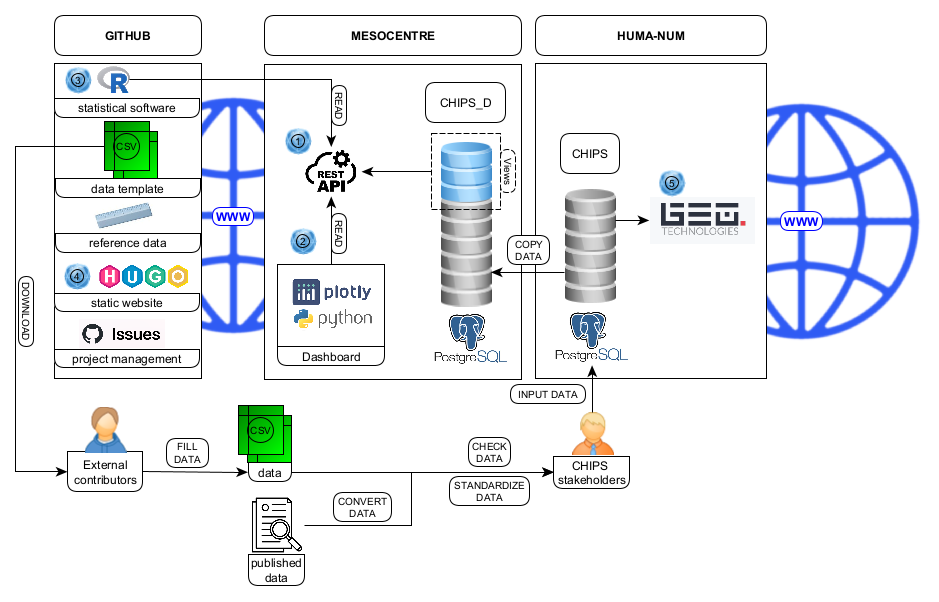
The CHIPS database is a key component of a broader workflow integrating web-oriented technologies, including an API, a Python dashboard, and an R package hosted on GitHub.

CHIPS project workflow. Circled numbers (1–5) refer to the following resources: 1. API (root): http://157.136.252.188:3000/; 2. Dashboard: https://iramat-apps.cnrs.fr/dash/; 3. iRamat R package: https://github.com/iramat/iRamat; 4. Website: https://iramat.github.io/chips; 5. GEO platform: https://fnp.huma-num.fr/adws/app/efbc5983-40d6-11ec-810c-a7f8dd92e681/.
References
Bibliographic references used to create the datasets
- Alexandre Disser, Philippe Dillmann, Marc Leroy, Maxime L'Héritier, Sylvain Bauvais, Philippe Fluzin. 2017. “Iron Supply for the Building of Metz Cathedral: New Methodological Development for Provenance Studies and Historical Considerations”. Archaeometry 59. https://onlinelibrary.wiley.com/doi/full/10.1111/arcm.12265.
- Anne-Marie Desaulty. 2008. “Apport des analyses chimiques multi technique à la compréhension du comportement des éléments traces dans les filières sidérurgiques anciennes. Application aux études de provenance et à la distinction des procédés. Le cas du Pays de Bray normand.”. https://theses.hal.science/tel-00552060.
- Anne-Marie Desaulty, Clarisse Mariet, Philippe Dillmann, Jean-Louis Joron, Philippe Fluzin. 2008. “A provenance study of iron archaeological artefacts by Inductively Coupled Plasma-Mass Spectrometry multi-elemental analysis”. Spectrochimica Acta Part B: Atomic Spectroscopy 63. https://www.sciencedirect.com/science/article/pii/S0584854708002589.
- Gaspard Pagès, Alexandre Disser. 2026. “Geochemical reference data on ancient iron industry from Ariège, Aude, Pyrénées-Orientales (Occitanie, France) and Andorra”. Journal of Open Archaeology Data 14. https://openarchaeologydata.metajnl.com/articles/10.5334/joad.200.
- Gaspard Pagès, Philippe Dillmann, Enrique Vega, Marion Berranger, Sylvain Bauvais, Luc Long, Philippe Fluzin. 2022. “Vice-versa: The iron trade in the western Roman Empire between Gaul and the Mediterranean”. PLOS ONE 17. https://journals.plos.org/plosone/article?id=10.1371/journal.pone.0268209.
- Grzegorz Żabiński, Jarosław Gramacki, Artur Gramacki, Ivan S. Stepanov, Marcin Woźniak. 2023. “Old wine into new wineskins? “Legacy data” in research on Roman Period East Germanic iron smelting”. PLOS ONE 18. https://journals.plos.org/plosone/article?id=10.1371/journal.pone.0289771.
- Guillaume Saint-Didier. 2017. “La métallurgie du fer dans le Poitou : extraction, réduction, forgeage (IIIe siècle av. J.-C. - XVe siècle)”. https://theses.univ-nantes.fr/vufind/Record/PPN200704079/Description.
- Jean Milot, Franck Poitrasson, Sandrine Baron, Marie-Pierre Coustures. 2016. “Iron isotopes as a potential tool for ancient iron metals tracing”. Journal of Archaeological Science 76. https://www.sciencedirect.com/science/article/pii/S0305440316301480#bib61.
- Katja Mittelstädt, Ullrich Himmelmann, Christoph Berthold, Roland Schwab. 2022. “Slag characterization from the Roman vicus of Eisenberg (Germany)”. Archaeological and Anthropological Sciences 14. https://doi.org/10.1007/s12520-022-01614-2.
- Ludwig Eschenlohr. 2001. “Recherches archéologiques sur le district sidérurgique du Jura central suisse”. Cahiers d archéologie romande 88. https://www.e-periodica.ch/digbib/view?pid=car-001%3A2001%3A88%3A%3A4.
- Marc Leroy. 1997. “La Sidérurgie en Lorraine avant le haut fourneau. L'utilisation du minerai de fer oolithique en réduction directe”. CNRS Editions. https://www.cnrseditions.fr/catalogue/prehistoire/la-siderurgie-en-lorraine-avant-le-haut-fourneau/.
- Marc Leroy, Paul Merluzzo. 2024. “Ateliers de production du fer et savoir-faire techniques en Lorraine aux XIIIe-XVe siècles”. Editions de l'Université de Lorraine. https://editions.univ-lorraine.fr/edul/catalog/book/b9782384512263.
- Marco Benvenuti, Andrea Dini, Massimo dOrazio, Laura Chiarentini, Alessandro Corretti, Pilario Costagliola. 2013. “The Tungsten and Tin signature of iron ores from Elba island (Italy): a tool for provenance studies of iron production in the mediterranean region”. Archaeometry 55. https://onlinelibrary.wiley.com/doi/10.1111/j.1475-4754.2012.00692.x.
- Marie-Pierre Coustures, Didier Béziat, Francis Tollon, Claude Domergue, Luc Long, André Rébiscoul. 2003. “THE USE OF TRACE ELEMENT ANALYSIS OF ENTRAPPED SLAG INCLUSIONS TO ESTABLISH ORE – BAR IRON LINKS: EXAMPLES FROM TWO GALLO-ROMAN IRON-MAKING SITES IN FRANCE (LES MARTYS, MONTAGNE NOIRE, AND LES FERRYS, LOIRET)”. Archaeometry 45. https://onlinelibrary.wiley.com/doi/full/10.1046/j.1475-4754.2003.00131.x.
- Marion Berranger, Marc Leroy, Jean-Pierre Piétak, Olivier Girardclos, Paul Merluzzo, Eddy Foy, Enrique Vega. 2026. “Bloomery slags from Puisaye (France): reconstructing technological changes in a major iron production area from the Iron Age to the Late Middle Ages”. Journal of Archaeological Science 187. https://www.sciencedirect.com/science/article/pii/S0305440326000051.
- Maxime L'Héritier, Philippe Dillmann, Guillaume Sarah. 2020. “Deciphering the Iron Provenance on a Medieval Building Yard: The Case of Bourges Cathedral”. Minerals 10. https://www.mdpi.com/2075-163X/10/12/1131.
- Michael Brauns, Roland Schwab, Guntram Gassmann, Günther Wieland, Ernst Pernicka. 2013. “Provenance of Iron Age iron in southern Germany: a new approach”. Journal of Archaeological Science 40. https://www.sciencedirect.com/science/article/pii/S0305440312004001.
- Paola Mameli, Giovanni Mongelli, Giacomo Oggiano, Daniela Rovina. 2014. “First Finding of Early Medieval Iron Slags in Sardinia (Italy): A Geochemical–Mineralogical Approach to Insights into Ore Provenance and Work Activity”. Archaeometry 56. https://onlinelibrary.wiley.com/doi/10.1111/arcm.12019.
- Philippe Dillmann, Roland Schwab, Sylvain Bauvais, Michael Brauns, Alexandre Disser, Stéphanie Leroy, Guntram Gassmann, Philippe Fluzin. 2017. “Circulation of iron products in the North-Alpine area during the end of the first Iron Age (6th-5th c. BC): A combination of chemical and isotopic approaches”. Journal of Archaeological Science 87. https://www.sciencedirect.com/science/article/pii/S0305440317301486#fig4.
- Ragnar Saage, Peeter Paaver, Kristo Oks. 2026. “RAUR project - Chemical data on slag samples related to ancient ironmaking activities in Estonia”. https://zenodo.org/records/18793710.
- Stéphanie Leroy, Serge Cohen, Catherine Verna, Bernard Gratuze, Florian Téreygeol, Philippe Fluzin, Loic Bertrand, Philippe Dillmann. 2012. “The medieval iron market in Ariège (France). Multidisciplinary analytical approach and multivariate analyses”. Journal of Archaeological Science 39. https://www.sciencedirect.com/science/article/pii/S0305440311004468#tbl5.
- Tajana Sekelj Ivančan, Tena Karavidović (eds.). 2021. “Interdisciplinary Research into Iron Metallurgy along the Drava River in Croatia: The TransFER Project”. Archaeopress. https://www.jstor.org/stable/j.ctv20rsk2k.
- Tim Young. 1999. “Fe and Mn ores from Paviland”. GeoArch reports 1999. https://www.geoarch.co.uk/reports/1999-08%20Paviland%20ores.pdf.
- Tim Young. 2006. “Archaeometallurgical residues from Coldfurrow, Lyonshall, Herefordshire”. GeoArch reports 2006. https://www.geoarch.co.uk/reports/2006-09%20Coldfurrow%20slags%20final.pdf.
- Tim Young. 2006. “Archaeometallurgical residues from Coolamurry 7, 04E0323”. GeoArch reports 2006. https://www.geoarch.co.uk/reports/2006-10%20Moneytucker%20Final%20Report%20revised.pdf.
- Tim Young. 2006. “Archaeometallurgical residues from High Island, Co. Galway (95E0124)”. GeoArch reports 2006. https://www.geoarch.co.uk/reports/2006-04%20High%20Island%20archaeometallurgy%20revised.pdf.
- Tim Young. 2007. “Archaeometallurgical residues from Cherryville Site 12, Kildare Bypass”. GeoArch reports 2007. https://www.geoarch.co.uk/reports/2007-24%20Cherryville%20Final%20Report.pdf.
- Tim Young. 2007. “Archaeometallurgical residues from Richard Lander School (RLS04) and Truro College (TCF05)”. GeoArch reports 2007. https://www.geoarch.co.uk/reports/2007-22%20Truro%20Final%20report.pdf.
- Tim Young. 2008. “Archaeometallurgical residues from Clonfad 3, Co. Westmeath (A001: 036 E2723)”. GeoArch reports 2008. https://www.geoarch.co.uk/reports/2008-17%20Clonfad%20final%20v4.pdf.
- Tim Young. 2009. “Archaeometallurgical residues from Ballykilmore, Co. Westmeath, E2798”. GeoArch reports 2009. https://www.geoarch.co.uk/reports/2009-16%20Ballykilmore%20final%20report%20v2.pdf.
- Tim Young. 2009. “Archaeometallurgical residues from Crickhowell Road, Trowbridge, Cardiff”. GeoArch reports 2009. https://www.geoarch.co.uk/reports/2009-02%20Residues%20from%20Crickhowell%20Road%20_revised_.pdf.
- Tim Young. 2009. “Archaeometallurgical Residues from Portwall Lane, Bristol (BSRMG 2006/17)”. GeoArch reports 2009. https://www.geoarch.co.uk/reports/2009-34%20Portwall%20Lane%20final%20report.pdf.
- Tim Young. 2009. “Ferrous archaeometallurgical residues from Woodstown 6”. GeoArch reports 2009. https://www.geoarch.co.uk/reports/2009-22%20Woodstown%206%20ferrous%20slags.pdf.
- Tim Young. 2009. “Iron ores from Adamstown 3”. GeoArch reports 2009. https://www.geoarch.co.uk/reports/2009-23%20Adamstown%203%20iron%20ores.pdf.
- Tim Young. 2010. “Analysis of archaeometallurgical residues from Brownslade, Pembrokeshire [NPRN 94225]”. GeoArch reports 2010. https://www.geoarch.co.uk/reports/2010-07%20Brownslade%20residues%20final.pdf.
- Tim Young. 2010. “Analysis of bog iron ore from Littleton Manor, Reigate, Surrey”. GeoArch reports 2010. https://www.geoarch.co.uk/reports/2010-20%20Reigate%20bog%20ore.pdf.
- Tim Young. 2010. “Archaeometallurgical residues from Domgay Lane, Four Crosses, Powys”. GeoArch reports 2010. https://www.geoarch.co.uk/reports/2010-23%20Four%20Crosses%20archaeometallurgical%20final%20report%20(revised).pdf.
- Tim Young. 2010. “Archaeometallurgical residues from Robeston Wathen, Pembrokeshire”. GeoArch reports 2010. https://www.geoarch.co.uk/reports/2010-09%20Robeston%20Wathen%20final%20report.pdf.
- Tim Young. 2010. “Archaeometallurgical residues from the South Hook LNG terminal”. GeoArch reports 2010. https://www.geoarch.co.uk/reports/2010-04%20South%20Hook%20fuel%20ash%20slags%20final.pdf.
- Tim Young. 2011. “Analysis of archaeometallurgical residues from Carrickmines Great, Co. Dublin [00E0525]”. GeoArch reports 2011. https://www.geoarch.co.uk/reports/2011-26%20Residues%20from%20Carrickmines%20Great.pdf.
- Tim Young. 2011. “Analysis of archaeometallurgical residues from Cleobury Park Furnace, Shropshire”. GeoArch reports 2011. https://www.geoarch.co.uk/reports/2011-28%20Residues%20from%20Cleobury%20Park%20Furnace.pdf.
- Tim Young. 2011. “Archaeometallurgical residues from Little Furnace Wood, Mayfield, East Sussex”. GeoArch reports 2011. https://www.geoarch.co.uk/reports/2011-21%20Residues%20from%20Little%20Furnace%20Wood.pdf.
- Tim Young. 2011. “Archaeometallurgical residues from Ned’s Garden & Cindermill, Shropshire”. GeoArch reports 2011. https://www.geoarch.co.uk/reports/2011-10%20Medieval%20slags%20from%20Shropshire.pdf.
- Tim Young. 2011. “Archaeometallurgical residues from the M1 Northern Motorway (J2009): Lagavooren 7, Co. Meath (00E0914)”. GeoArch reports 2011. https://www.geoarch.co.uk/reports/2011-16%20Metallurgical%20residues%20from%20Platin-Lagavooren%201.pdf.
- Tim Young. 2011. “Archaeometallurgical residues from the N7 Castletown to Nenagh scheme, Camlin 1 (E3579), Co. Tipperary”. GeoArch reports 2011. https://www.geoarch.co.uk/reports/2011-22%20Residues%20from%20Camlin%201.pdf.
- Tim Young. 2011. “Archaeometallurgical residues from the N7 Castletown to Nenagh scheme, Camlin 3 (E3580), Co. Tipperary”. GeoArch reports 2011. https://www.geoarch.co.uk/reports/2011-23%20Residues%20from%20Camlin%203.pdf.
- Tim Young. 2012. “Archaeometallurgical residues from the Brecon to Tirley gas pipeline”. GeoArch reports 2012. https://www.geoarch.co.uk/reports/2012-18%20Residues%20from%20the%20Brecon%20to%20Tirley%20gas%20pipeline%20revised.pdf.
- Tim Young. 2013. “Analysis of archaeometallurgical residues, Cannop, Glos. (Glos HER 37920)”. GeoArch reports 2013. https://www.geoarch.co.uk/reports/2013-05%20Analysis%20of%20residues%20from%20Cannop.pdf.
- Tim Young. 2013. “Archaeometallurgical residues from Dwr-y-Felin School,Neath (GGAT 677 & 716)”. GeoArch reports 2013. https://www.geoarch.co.uk/reports/2013-27%20Residues%20from%20Neath.pdf.
- Tim Young. 2013. “Archaeometallurgical residues from The Milford Haven – Brecon Pipeline”. GeoArch reports 2013. https://www.geoarch.co.uk/reports/2013-30%20Residues%20from%20MHB%20final.pdf.
- Tim Young. 2014. “Analyses of ores and residues from Dunkeswell, Devon”. GeoArch reports 2014. https://www.geoarch.co.uk/reports/2014-31%20ores%20and%20residues%20from%20Dunkeswell%20(final).pdf.
- Tim Young. 2014. “Archaeometallurgical residues from Site 42N (Cinder Hill), Cutacre, Salford”. GeoArch reports 2014. https://www.geoarch.co.uk/reports/2014-34%20Residues%20from%20Cutacre.pdf.
- Tim Young. 2014. “Archaeometallurgical residues from Torr Quarry, Leighton, Wanstrow, Somerset”. GeoArch reports 2014. https://www.geoarch.co.uk/reports/2014-12%20Residues%20from%20Torr%20Quarry.pdf.
- Tim Young. 2014. “Archaeometallurgical residues from Twinyeo Farm, Devon (ACD170/ACD504)”. GeoArch reports 2014. https://www.geoarch.co.uk/reports/2014-10%20Residues%20from%20Twinyeo%20(final).pdf.
- Tim Young. 2016. “Archaeometallurgical residues from Churchills Farm, Hemyock, Devon”. GeoArch reports 2015. https://www.geoarch.co.uk/reports/2015-02%20Residues%20from%20Churchills%20Farm%20Hemyock%20v0.pdf.
- Tim Young. 2016. “Archaeometallurgical residues from Fleet Hill Farm, Finchampstead, Berkshire”. GeoArch reports 2016. https://www.geoarch.co.uk/reports/2016-35%20Residues%20from%20Fleethill%20Farm.pdf.
- Tim Young. 2016. “Archaeometallurgical residues from Hen Gastell, Llanwnda, Gwynedd”. GeoArch reports 2016. https://www.geoarch.co.uk/reports/2016-37%20Residues%20from%20Hen%20Gastell.pdf.
- Tim Young. 2016. “Archaeometallurgical residues from Llandre, Ceredigion”. GeoArch reports 2016. https://www.geoarch.co.uk/reports/2016-36%20Residues%20from%20Llandre.pdf.
- Tim Young. 2016. “Ironworking residues from Tregurra, Truro, Cornwall”. GeoArch reports 2016. https://www.geoarch.co.uk/reports/2016-40%20Tin%20ores%20from%20Tregurra.pdf.
- Tim Young. 2017. “Archaeometallurgical residues from Priory Field, Caerleon”. GeoArch reports 2017. https://www.geoarch.co.uk/reports/2017-17%20Residues%20from%20Priory%20Field%20Caerleon.pdf.
- Tim Young. 2017. “Archaeometallurgical residues from Staveley Road, Eckington, Derbyshire (SLE13 / ECSL17)”. GeoArch reports 2017. https://www.geoarch.co.uk/reports/2017-24%20Ironworking%20residues%20from%20Eckington%20revised.pdf.
- Tim Young. 2017. “Ironworking residues from Kingswood, Gloucestershire (ACW451)”. GeoArch reports 2017. https://www.geoarch.co.uk/reports/2017-06%20Ironworking%20residues%20from%20Kingswood%20v2.pdf.
- Tim Young. 2018. “Archaeometallurgical residues from Cleevelands, Bishop’s Cleeve Gloucestershire”. GeoArch reports 2018. https://www.geoarch.co.uk/reports/2018-12%20Ironworking%20residues%20from%20Cleevelands.pdf.
- Tim Young. 2018. “Archaeometallurgical residues from Folly Court, Wokingham, Berkshire”. GeoArch reports 2018. https://www.geoarch.co.uk/reports/2018-15%20Residues%20from%20Folly%20Court.pdf.
- Tim Young. 2018. “Archaeometallurgical residues from Parc Cybi, Holyhead, Ynys Môn”. GeoArch reports 2018. https://www.geoarch.co.uk/reports/2018-26%20Residues%20from%20Parc%20Cybi%20(full).pdf.
- Tim Young. 2019. “Analysis of iron smelting residues from Lydney B North (LYF17)”. GeoArch reports 2019. https://www.geoarch.co.uk/reports/2019-04%20Residues%20from%20Lydney.pdf.
- Tim Young. 2020. “Archaeometallurgical residues from Hartshill Copse (HCB01)”. GeoArch reports 2020. https://www.geoarch.co.uk/reports/2020-17%20Residues%20from%20Hartshill%20Copse%20HCB01.pdf.
- Tim Young. 2020. “Archaeometallurgical residues from Lockleaze”. GeoArch reports 2020. https://www.geoarch.co.uk/reports/2020-21%20Residues%20from%20Lockleaze.pdf.
- Tim Young. 2020. “Archaeometallurgical residues from north of Culmstock Road, Hemyock”. GeoArch reports 2020. https://www.geoarch.co.uk/reports/2014-11%20Residues%20from%20Culmstock%20Road%20Hemyock.pdf.
- Tim Young. 2021. “Analysis of archaeometallurgical residues from Lydney B North, Phase II”. GeoArch reports 2021. https://www.geoarch.co.uk/reports/2021-11%20Residues%20from%20Lydney%20B%20Phase%20II.pdf.
- Tim Young. 2021. “Archaeometallurgical residues from Cardiff Castle”. GeoArch reports 2021. https://www.geoarch.co.uk/reports/2021-03%20Residues%20from%20Cardiff%20Castle.pdf.
- Tim Young. 2021. “Archaeometallurgical residues from Langford, Devon”. GeoArch reports 2021. https://www.geoarch.co.uk/reports/2021-01%20Residues%20from%20Langford.pdf.
- Tim Young. 2022. “Archaeometallurgical residues from Bexhill”. GeoArch reports 2022. https://www.geoarch.co.uk/reports/2022-09%20Residues%20from%20Bexhill%20part%201.pdf.
- Tim Young. 2022. “Archaeometallurgical residues from the A43 Corby Link Road”. GeoArch reports 2022. https://www.geoarch.co.uk/reports/2022-10%20Residues%20from%20Corby.pdf.
- Vincent Serneels. 1993. “Archéométrie des scories de fer. Recherches sur la sidérurgie ancienne en Suisse occidentale”. Cahiers d archéologie romande 61. https://www.academia.edu/24899379/Arch%C3%A9om%C3%A9trie_des_scories_de_fer_recherches_sur_la_sid%C3%A9rurgie_ancienne_en_Suisse_romande.