Title here
Summary here
This page presents the database, its tables and fields, data input best practices, and the broader workflow for ensuring the reusability of CHIPS data. CHIPS aims to make iron physico-chemical analyses standardised, interoperable, and citable, while being grounded in Open Science through open-access publications, open-source software, and open data. We welcome external contributions to extend both the database (data) and the project’s functionalities (software).
The database is built on PostgreSQL 11 and PostGIS v2.5. It relies on a simple data structure whose backbone consists of a context–sample–chemistry triplet. Each of these components is described by metadata designed either to assess data quality or to promote interoperability.
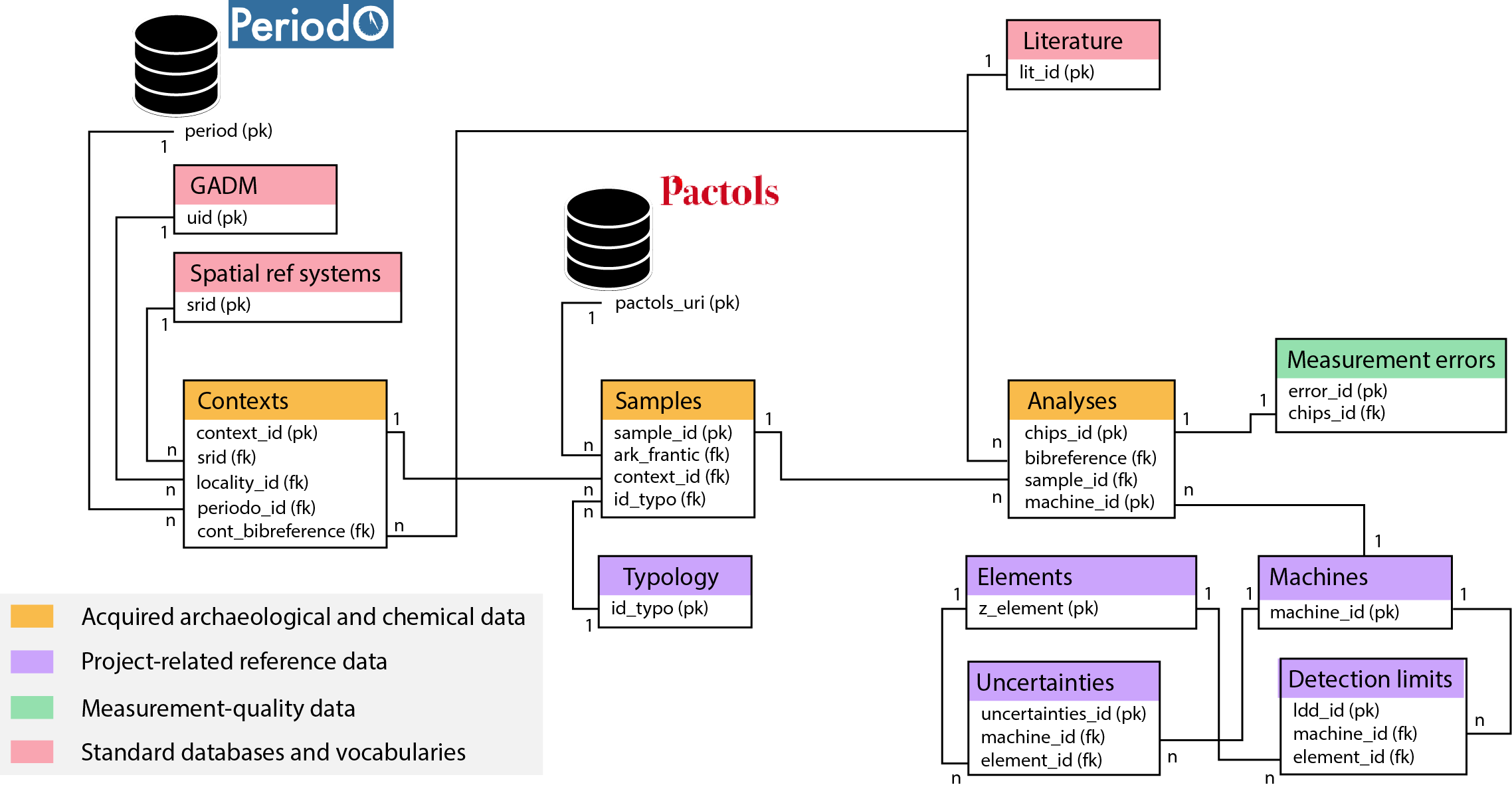
Simplified Entity–Relationship Diagram (ERD) of the CHIPS database.
This section provides description on tables and tables’ fields.
The dynamic datatable below describes the database tables:
The dynamic datatable below describes the fields of the database tables:
Reference data:
Open datasets, accessible throught the API, are listed here:
Recording measurement errors
The following protocol has been established for recording measurement errors:
machines table, specifying the type of chemical analysis, the laboratory, and the model of the analytical instrument used.machines table, each chemical element listed in the elements table, and a given concentration range, the relative measurement uncertainty is recorded in the uncertainties table.The query result shown in Figure 2 illustrates how these values are organised. Uncertainties 151 to 154 represent the relative measurement errors associated with the ICP-MS analyser used by the Centre de Recherches Pétrographiques et Géochimiques (CRPG) laboratory for the element yttrium. For concentrations above 50 mg·kg−1, the relative error is 5%. It increases to 15% for concentrations between 1 and 50 mg·kg−1, and reaches up to 100% for concentrations below 0.1 mg·kg−1.
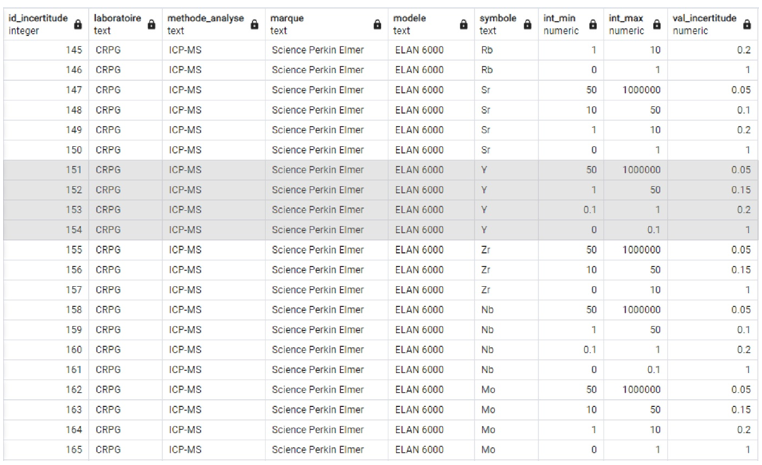
View based on the machines, elements, and uncertainties tables, showing relative measurement uncertainties according to the analytical setup and measured concentration range.
Further documentation is available in the iramat-dev GitHub repository:
https://github.com/iramat/iramat-dev/tree/main/dbs/chips
Contribute your data to CHIPS
An easy way to register your dataset in CHIPS and expose it as a standalone dataset is to complete and send us the template file chips_dataset_entry_template.xlsx, available for download from the CHIPS GitHub repository. Columns and value types are described in the Tables and values section of the database documentation.
Below is a preview of the template, including sample records from the dataset_rsaage26 dataset.
Beyond data standardisation and interoperability, the CHIPS project also aims to make datasets citable, meaning that your contribution can be cited independently of both the CHIPS database and other datasets.
The simplified workflow below illustrates how contributed data are processed: once submitted, datasets are reviewed, integrated into the database, and published as independent datasets—with full attribution to contributors—in an open-access data repository (here, Zenodo).
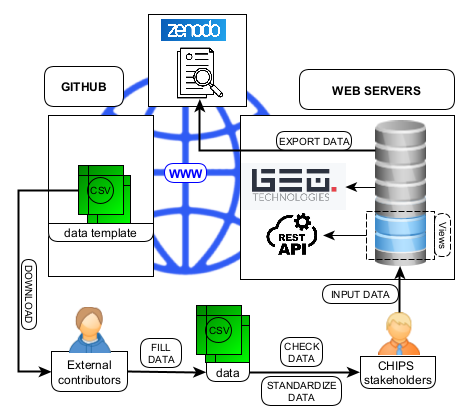
Simplified CHIPS publication workflow (thick arrows).
Unless otherwise specified, your data will be subject to the CC BY 4.0 license. See, for example, the dataset_rsaage26 dataset hosted on Zenodo.
Python dashboard and R research software development
The source code for both the Python dashboard and the R iRamat package is openly available online. If you would like to contribute to the software, please do not hesitate to contact us with suggestions or open an issue on the CHIPS GitHub repository.
Contact
For scientific questions (e.g., error calculations), please contact . For IT-related questions (e.g., linked open data), please contact . See also the Contact section.
Data coming from the CHIPS dashboard, from CSV exports, or directly from API URLs are separate entities distributed under the CC BY 4.0 license and can be cited individually (see the "reference" field). For example:

Cite a dataset exported from the API (from: http://157.136.252.188:3000/dataset_jmilot16)

Cite a dataset exported as CSV
The CHIPS database itself, which provides standardization and interoperability, should be cited separately:
@misc{chips_database,
  title        = {CHIPS Database -- CHImie en PaléoSidérurgie},
  author       = {{IRAMAT-CNRS}},
  institution  = {IRAMAT-CNRS},
  publisher    = {IRAMAT-CNRS},
  year         = {2026},
  url          = {https://iramat-apps.cnrs.fr/dash/},
  note         = {Online database, accessed 2026-05-11},
  organization = {IRAMAT-CNRS},
  ror          = {https://ror.org/01cw28e72}
}The CHIPS database is a key component of a broader workflow integrating web-oriented technologies, including an API, a Python dashboard, and an R package hosted on GitHub.
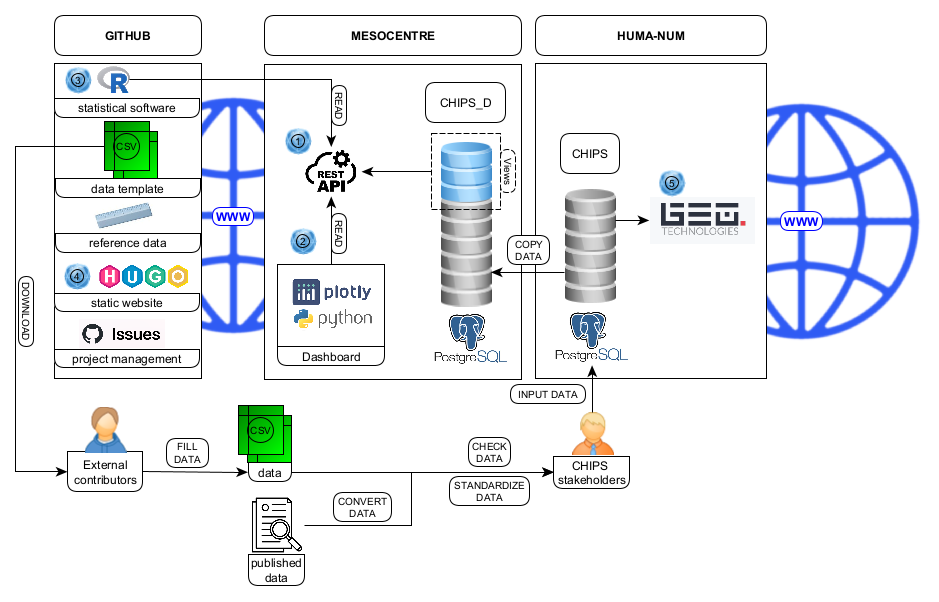
CHIPS project workflow. Circled numbers (1–5) refer to the following resources: 1. API (root): http://157.136.252.188:3000/; 2. Dashboard: https://iramat-apps.cnrs.fr/dash/; 3. iRamat R package: https://github.com/iramat/iRamat; 4. Website: https://iramat.github.io/chips; 5. GEO platform: https://fnp.huma-num.fr/adws/app/efbc5983-40d6-11ec-810c-a7f8dd92e681/.